

10 Recurring Organizational Patterns That Signal Declining Coherence Between Strategy and Execution
 06 / 01 / 2026
 345
345 10 organizational patterns of declining coherence between strategy and execution.
Part of the PCES™ Organizational Coherence Series
Most organizations do not suddenly fall into dysfunction. In fact, many continue to grow, deliver results, and appear operationally healthy long after internal fragmentation has already begun.
The change is usually gradual: more initiatives, more coordination, more exceptions, more adjustments, and progressively less clarity around what truly matters. Over time, organizations become increasingly reactive, overloaded, and dependent on managerial intervention simply to maintain execution stability. Each individual decision appears justified on its own. Yet cumulatively, the organization becomes increasingly overloaded, reactive, and dependent on executive intervention. Over time, this creates growing difficulty in coordinating execution effectively.
These are the cumulative effects of a progressive degradation of coherence between strategy and execution. Within the PCES model (Pressure – Coherence – Exceptions – Simplification), this is the core dynamic being addressed: organizational pressure generates an accumulation of initiatives, exceptions, control mechanisms, coordination layers, and continuous adjustments. As this accumulation grows, organizational complexity increases while coherence declines — which, in turn, creates even more pressure.
This cyclical process often remains invisible. Most organizations recognize execution degradation much later, because on the surface results may still appear acceptable and the business may continue to grow.
Internally, execution still appears active, yet an increasing share of management attention is redirected toward keeping the organization synchronized as priorities shift more frequently and execution predictability begins to decline.
In the PCES model, this degradation becomes visible through a series of observable organizational patterns. These patterns are not isolated problems. Rather, they represent:
- recurring organizational manifestations
- observable structural tensions
- and mechanisms through which pressure begins to affect execution stability
The distinction between “Do we have a problem?” and “Where are we in the gradual degradation process between strategy and execution?” is essential.
Below are 10 organizational patterns that most commonly emerge when organizations operate under pressure.
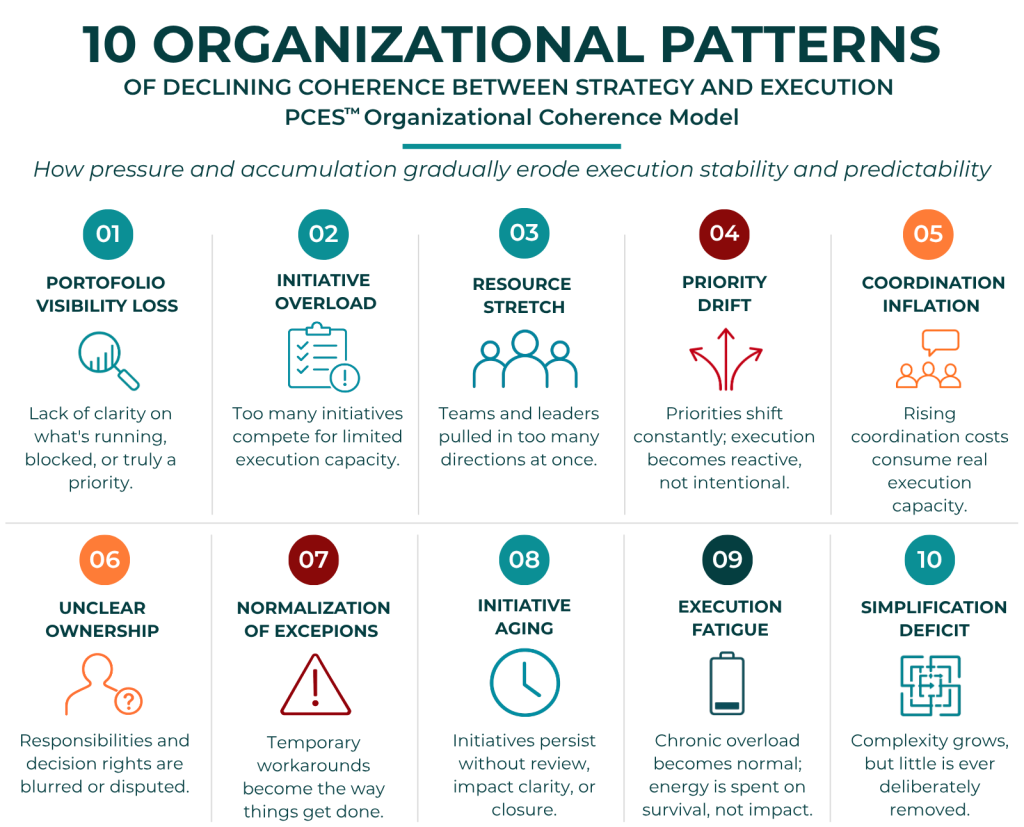
How Can These Patterns Be Used in Practice?
1. As a Rapid Organizational Diagnostic Tool
These patterns can be used to quickly assess the level of organizational pressure, accumulation, and fragmentation.
A structured set of questions based on these patterns can rapidly reveal the degree of fragmentation within an organization. Towards the end of this article, you will find a short organizational self-assessment designed to identify early signals of pressure, fragmentation, and declining execution coherence.
In practice, the inability to answer these questions clearly often reveals the problem itself.
2. As a Shared Executive Language
One of the greatest challenges in organizations operating under pressure is that symptoms are experienced in fragmented ways: operationally, functionally, contextually, or individually.
The PCES model provides a common language for discussing organizational dynamics that otherwise remain implicit, subjective, or difficult to articulate across functions.
As a result, conversations become more structured around observable dimensions such as:
- organizational pressure
- execution stability
- the volume and role of exceptions
- simplification capability
- and the real cost of coordination
In many organizations, being able to name and discuss these dynamics explicitly already creates significant executive clarity.
3. As an Entry Point for Organizational Stabilization
These patterns do not automatically suggest that an organization requires a major transformation initiative. In most cases, they indicate where coherence begins to deteriorate and what type of stabilization intervention may become necessary. For example:
- initiative accumulation may indicate the need for reprioritization and simplification
- growing coordination costs may signal the need for structural clarity
- and normalized exceptions may indicate the absence of sustainable execution mechanisms
In this sense, the PCES model does not merely identify problems. It provides:
- a framework for interpreting organizational accumulation
- an early detection system
- and a way for organizations to recognize earlier when complexity begins exceeding clarity and when execution predictability begins degrading structurally.
Below is a more detailed look at how each pattern typically emerges and evolves under pressure
1. Portfolio Visibility Loss
This is one of the earliest organizational patterns to emerge. Organizations often struggle to answer a seemingly simple question quickly and clearly: “How many strategic initiatives are currently running simultaneously?”
This usually happens because initiatives:
- accumulate gradually
- are distributed across functions
- have fragmented ownership
- and are added contextually over time.
Simple questions such as:
- “Which initiatives are currently active or blocked?”
- “Which initiatives are truly strategic priorities?”
- “Which initiatives no longer have a clearly defined impact?”
become increasingly difficult to answer. As visibility declines, organizations lose the ability to prioritize coherently what they can no longer systematically see.
2. Initiative Overload
At this stage, the organization’s real execution capacity is exceeded by the growing number of accumulated initiatives. While many organizations have mature processes for launching initiatives, approving projects, and allocating budgets, deliberate mechanisms for stopping, consolidating, or eliminating initiatives are far less common.
At first glance, every initiative appears justified by different reasons: growth, optimization, transformation, digitalization, restructuring.
Initially, these initiatives are viewed as part of a broader strategy for growth and market opportunity capture. The portfolio expands gradually. However, expansion does not necessarily mean progress. In many cases, it signals growing strategic overload and fragmentation.
3. Resource Stretch
This is the point where fragmentation begins to produce direct operational effects. Key teams and critical managers become simultaneously involved in:
- day-to-day operations
- strategic projects
- transformation efforts
- reporting and corrective actions
- and contextual emergencies
In practice, this creates high levels of organizational multitasking and a constant state of change that reduces actual execution focus and speed. At the same time, prioritization is no longer performed explicitly and strategically. Instead, it becomes implicit, driven by immediate pressure and urgency.
Organizations begin working harder simply to maintain the same level of progress.
4. Priority Drift
Priorities begin to shift continuously, and the organization no longer executes a coherent plan. Instead, execution becomes a sequence of ongoing adjustments. The organization may still have a strategy and action plans. Priorities may still be communicated frequently.
However, day-to-day execution increasingly becomes dominated by recurring adjustments, escalations, emergencies, and shifting priorities.
Adaptability is essential in dynamic environments. The problem emerges when continuous reprioritization starts replacing deliberate execution rather than supporting it.
This is one of the most important PCES patterns because the organization gradually shifts from deliberate execution toward continuous reactive adjustment.
5. Coordination Inflation / High Coordination Dependency
This is one of the clearest indicators that increasing amounts of organizational energy are being consumed by synchronization.
In coherent organizations, coordination supports execution. In fragmented organizations, coordination begins compensating for the lack of structural clarity and progressively consumes real execution capacity.
As a result:
- repetitive alignment meetings emerge
- operational synchronization becomes constant
- recurring clarifications become necessary
- and managerial intervention becomes increasingly required
Management attention gradually shifts away from strategic thinking and toward synchronization, escalation management, follow-up, and continuous alignment. This gradually becomes one of the most expensive invisible costs of organizational fragmentation.
6. Unclear Ownership
As initiatives overlap, exceptions grow, and priorities continue shifting, responsibilities and decision rights around cross-functional initiatives and activities become increasingly unclear. This creates:
- overlapping responsibilities
- organizational gray zones
- recurring escalations between functions
- and excessive dependency on key individuals.
At this point, coordination begins compensating for the absence of structural clarity.
7. Normalization of Exceptions
Exceptions are natural in healthy systems. The problem emerges when exceptions accumulate, can no longer be monitored effectively, and no longer have expiration mechanisms. At that stage, organizations begin developing an informal execution infrastructure.
Typical signals include:
- bypassing standard processes to solve issues quickly
- constantly accelerated approvals
- recurring exemptions
- permanent improvised solutions
- and operational reinterpretation of rules
Once these mechanisms become dominant, the organization no longer operates through a clearly defined structure, but through a growing network of organizational deviations.
8. Initiative Aging
This is one of the most subtle and difficult organizational patterns to recognize. Many initiatives are no longer periodically reevaluated, explicitly stopped, or assessed based on clearly defined impact.
Instead, they continue due to inertia, the difficulty of stopping them, organizational accumulation, or the absence of formal simplification mechanisms. The result is a progressively heavier organization that gradually normalizes initiative accumulation. In many organizations, there are initiatives for which nobody can clearly explain:
- whether they are still priorities
- whether they still create value
- or who is explicitly responsible for stopping them.
Unlike Initiative Overload, which reflects excessive initiative volume, Initiative Aging reflects the organization’s inability to deliberately reevaluate, consolidate, or stop initiatives over time.
9. Execution Fatigue
The organization becomes accustomed to functioning through continuous overconsumption of managerial and operational energy. Under pressure, most organizations naturally respond by adding more control, more reporting, more approvals, and more verification mechanisms. The intention is usually positive.
However, after a certain threshold of continuous accumulation, the organization begins consuming more energy than the value generated by the control mechanisms. This leads to chronic overload, continuous acceleration, and dependency on key individuals. In many organizations, this fatigue becomes normalized. Constant acceleration starts being interpreted as commitment, while chronic overload becomes embedded in the operating culture.
The organization does not stop functioning, but it gradually loses the ability to allocate managerial and operational energy proportionally and sustainably.
10. Simplification Deficit
This is one of the most important structural patterns. The organization continuously adds complexity but no longer implements deliberate mechanisms for elimination and simplification. Organizational complexity grows naturally, yet simplification mechanisms are often neglected.
This becomes one of the primary drivers of operational fragmentation: the subtle accumulation of initiatives and exceptions.
Why Are These Patterns Difficult to Observe?
Because individually, each initiative appears justified. Initiatives are part of organizational functioning. Exceptions can be useful. Adjustments seem reasonable. Coordination appears logical. Control mechanisms feel responsible. The difficulty is not that these elements exist.
The difficulty is that they accumulate continuously, without a clear perception of how they gradually make the organization harder to operate effectively.
Why Do These Patterns Matter?
These patterns do not necessarily indicate that an organization is in crisis. Rather, they indicate that mechanisms of accumulation are beginning to exceed mechanisms of clarity, simplification, and sustainable coordination.
In many cases, performance still exists, growth continues, and the organization remains operational. However, predictability declines, coordination increases, and management consumes progressively more organizational energy. Execution becomes more fragile, more volatile, and increasingly dependent on coordination and managerial intervention.
The risk is not simply operational inefficiency. The deeper risk is that organizations gradually lose the ability to execute strategy predictably without increasing levels of coordination, intervention, and organizational strain.
Depending on context, the effects may become visible through:
- slower execution
- prioritization difficulties
- increasing coordination costs
- operational volatility
- declining implementation speed
- and scaling difficulties
Organisational Patterns Assessment link here.
This article expands on the broader PCES™ perspective regarding organizational pressure, execution fragmentation, and coherence degradation.
________________________________
About the PCES™ Model
PCES™ (Pressure – Coherence – Exceptions – Simplification) is an organizational coherence model focused on understanding how execution gradually becomes fragmented under increasing pressure, accumulation, and coordination complexity.
Rather than focusing exclusively on performance optimization, PCES™ examines the structural sustainability of execution: how organizations accumulate initiatives, normalize exceptions, increase coordination dependency, and progressively lose execution predictability over time.
The model provides:
- a framework for interpreting organizational accumulation,
- an early detection system for execution fragmentation,
- and a shared executive language for discussing structural organizational pressure before visible operational breakdown occurs.
PCES™ is designed as a strategic organizational sense-making and coherence stabilization model for leadership teams operating in increasingly complex execution environments. For the foundational PCES™ framework and the underlying organizational dynamics model, you can read the flagship article here.
A limited number of executive diagnostic discussions are available for organizations interested in exploring the model within their own operating context.
For details or to schedule a conversation:
Ionuț-Ciprian Zaharia
Founder, Enovise Present
Organizational transformation, digitalization and strategy–execution alignment advisor
Email: ionutzaharia@enovisepresent.com
 06 / 01 / 2026
  345
345